Training Guide 13
Puzzle Books — pick a theme, get a book of puzzles
Ebook Creator now makes puzzle books as well as written books. Choose a theme, who it is for, and the kinds of puzzle you want — word search, crossword, sudoku, maze, word scramble, cryptogram and number search — and you get a print-ready paperback with every puzzle, a full answer key at the back, a wrap cover, and the checklist for publishing on Amazon KDP.
01 What you get
A paperback you can publish, not a folder of puzzles.
The puzzle book as a PDF
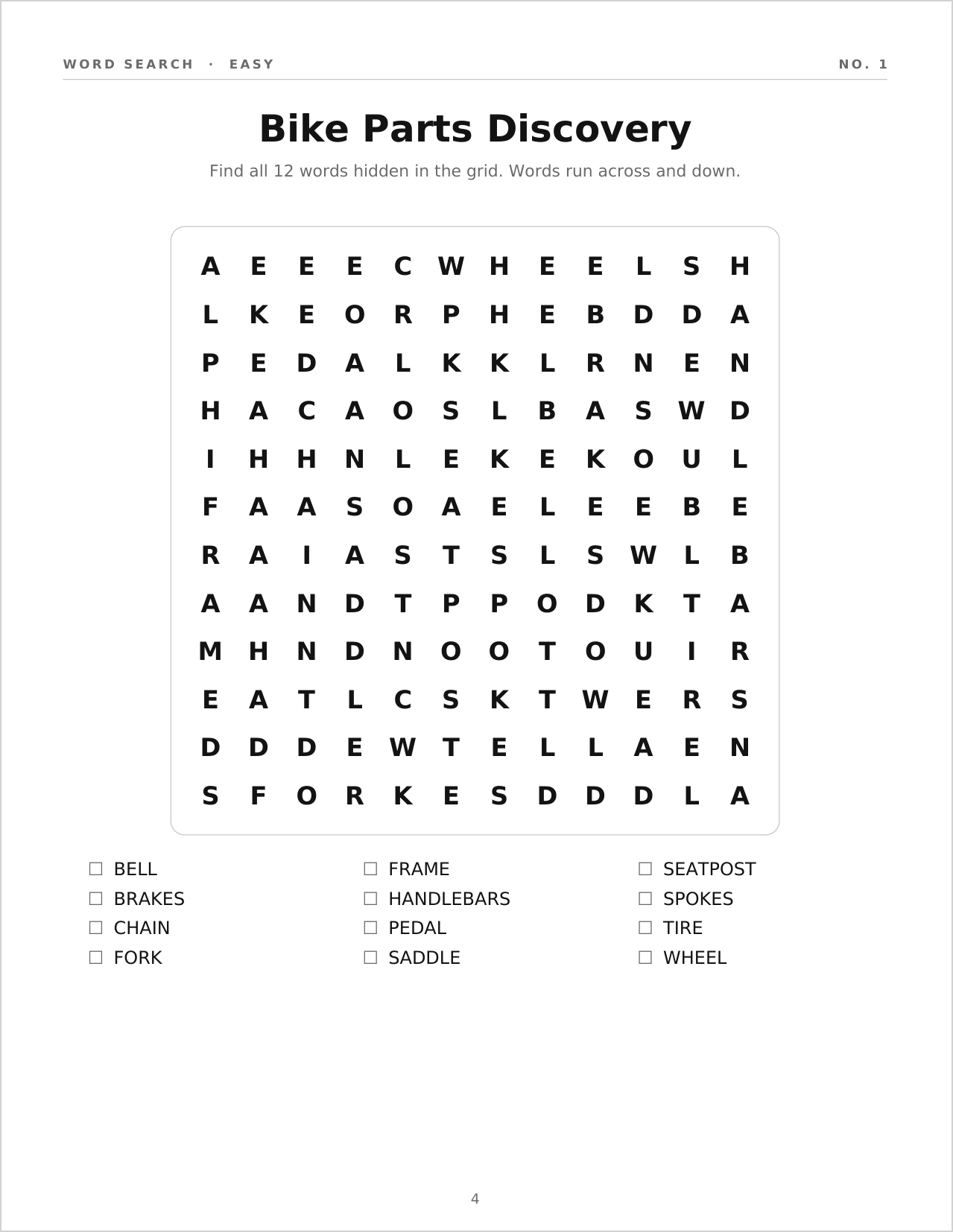
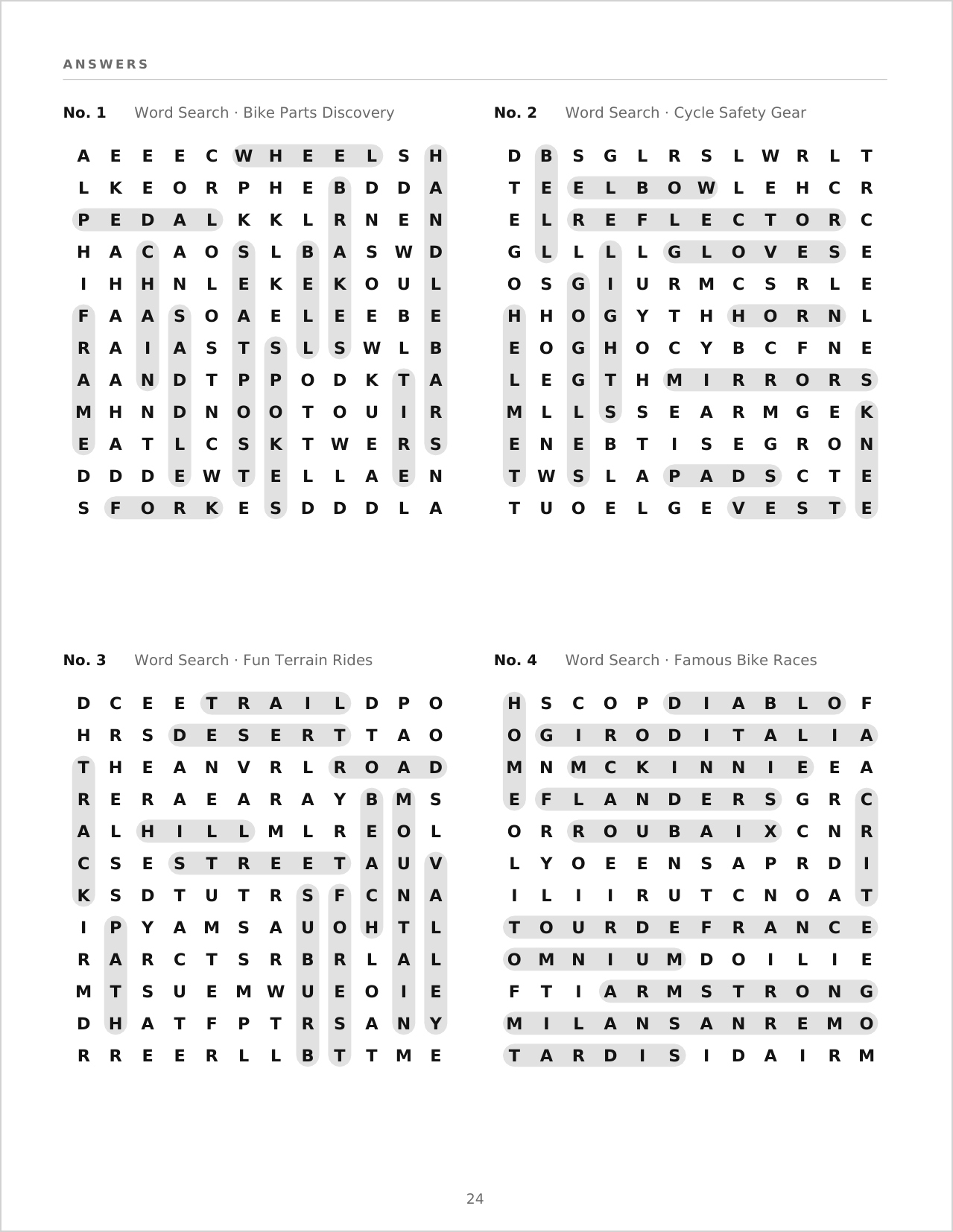
Title page, a How to Play page, one puzzle per page, and every answer at the back, four to a page.
Print-ready paperback interior
Clean black-and-white pages at your trim size, with KDP margins and fonts embedded.
A full-wrap cover
Back, spine and front on one page, with bleed, and the spine sized to your real page count.
A KDP upload checklist
Trim, margins, spine width, page count, and a ready-to-paste description for your listing.
02 Switching to Puzzle book
Same tool, same page — one switch at the top.
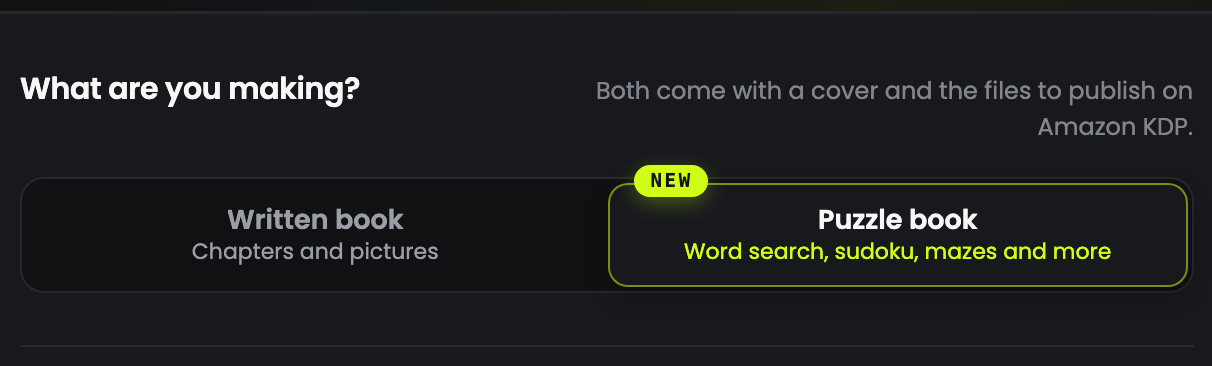
Open Ebook Creator
From the sidebar, Ebook Creator - KDP.
Choose Puzzle book
The form changes to the puzzle settings, and the panel on the right becomes YOUR PUZZLE BOOK. The page remembers your last choice next time.
03 Step 1 — Theme & reader
Two settings that shape every word in the book.
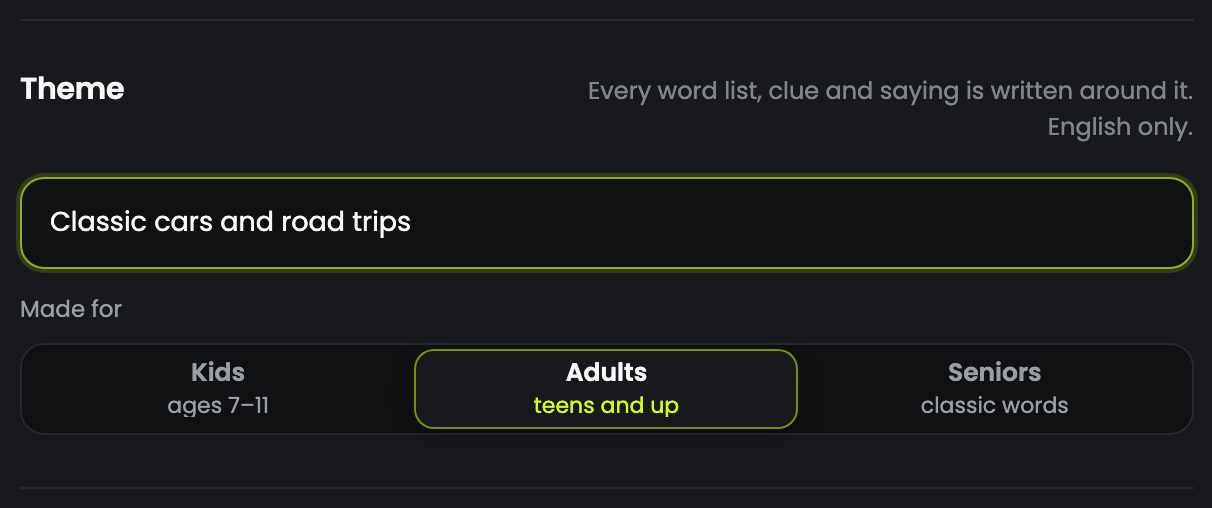
| Setting | What it does |
|---|---|
| Theme | What the book is about, in a few words — e.g. Classic cars and road trips. Each puzzle gets its own topic within it. English only. |
| Kids ages 7–11 | Simpler words and clues a child will know. |
| Adults teens and up | The full vocabulary for a general reader. |
| Seniors classic words | Familiar, classic words and references. |
Too broad
"Animals."
Every puzzle ends up with the same few dozen words.
Better
"Birds of the British garden, through the seasons."
Enough range for sixty different puzzles, and a clear reader to sell to.
04 Step 2 — The puzzles
Seven kinds. Pick as many as you like — none are picked for you.
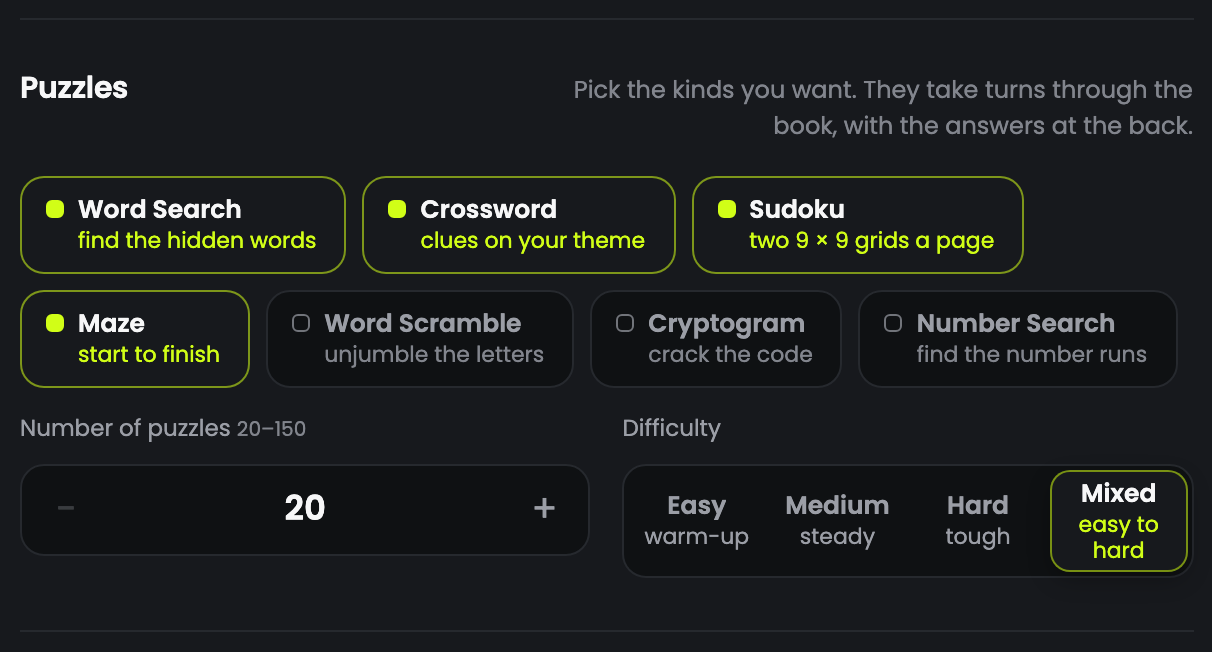
| Kind | The puzzle | Uses word credits? |
|---|---|---|
| Word Search | Find the themed words hidden in a letter grid, from a word list below it. | Yes — the word list |
| Crossword | Clues on your theme; the number in brackets is the answer length. | Yes — the most, because of the clues |
| Sudoku | Fill every row, column and 3 × 3 box with 1 to 9. Two grids on each page. | No |
| Maze | Find the one path from START to FINISH. | No |
| Word Scramble | Unscramble the letters to find each themed word. | Yes — the word list |
| Cryptogram | Each letter stands for another; crack the code to reveal a saying. The sayings are original, never famous quotes. | Yes — the sayings |
| Number Search | Find the number runs hidden in a digit grid. | No |
Pick at least one kind
Nothing is ticked when you arrive. Until you pick, the panel says no kinds picked and the button asks you to pick at least one kind of puzzle.
They take turns
Pick Word Search, Crossword and Sudoku and the book runs word search, crossword, sudoku, word search, crossword, sudoku… so the kinds are spread evenly.
One kind is fine too
A book of only word searches, or only sudoku, is one of the best-selling formats there is.
05 Step 3 — How many, how hard
Between 20 and 150 puzzles, at four difficulty settings.
| Setting | Options |
|---|---|
| Number of puzzles | 20 to 150, with the − / + stepper. Each puzzle is one page. |
| Difficulty | Easy — warm-up · Medium — steady · Hard — tough · Mixed — easy to hard |
What difficulty changes
On the 8.5 × 11 size. The 6 × 9 travel size uses slightly smaller grids and fewer words so everything still fits the page.
| Kind | Easy | Medium | Hard |
|---|---|---|---|
| Word Search | 12 × 12 grid, 12 words, across and down | 14 × 14, 16 words, also diagonal | 15 × 15, 20 words, any direction including backwards |
| Crossword | 10 words | 14 words | 18 words |
| Sudoku | 38 numbers given | 31 given | about 26 given |
| Maze | 12 × 15 cells | 18 × 23 | 24 × 30 |
| Word Scramble | 12 words | 16 words | 20 words |
| Cryptogram | 3 letters given as hints | 2 hints | 1 hint |
| Number Search | 12 numbers, 4–5 digits | 16 numbers, 5–6 digits | 20 numbers, 6–8 digits |
06 Step 4 — The cover
The only picture in the book.
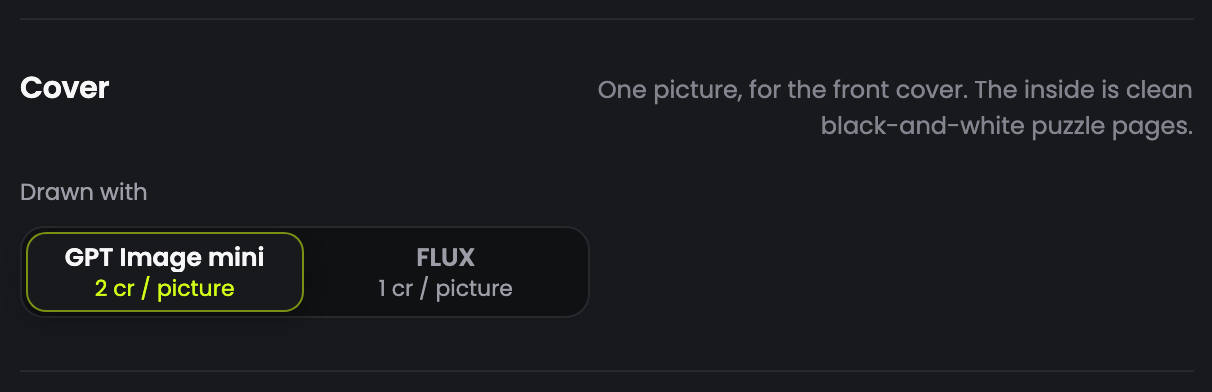
| Drawn with | Cost |
|---|---|
| GPT Image mini | 2 media credits |
| FLUX | 1 media credit |
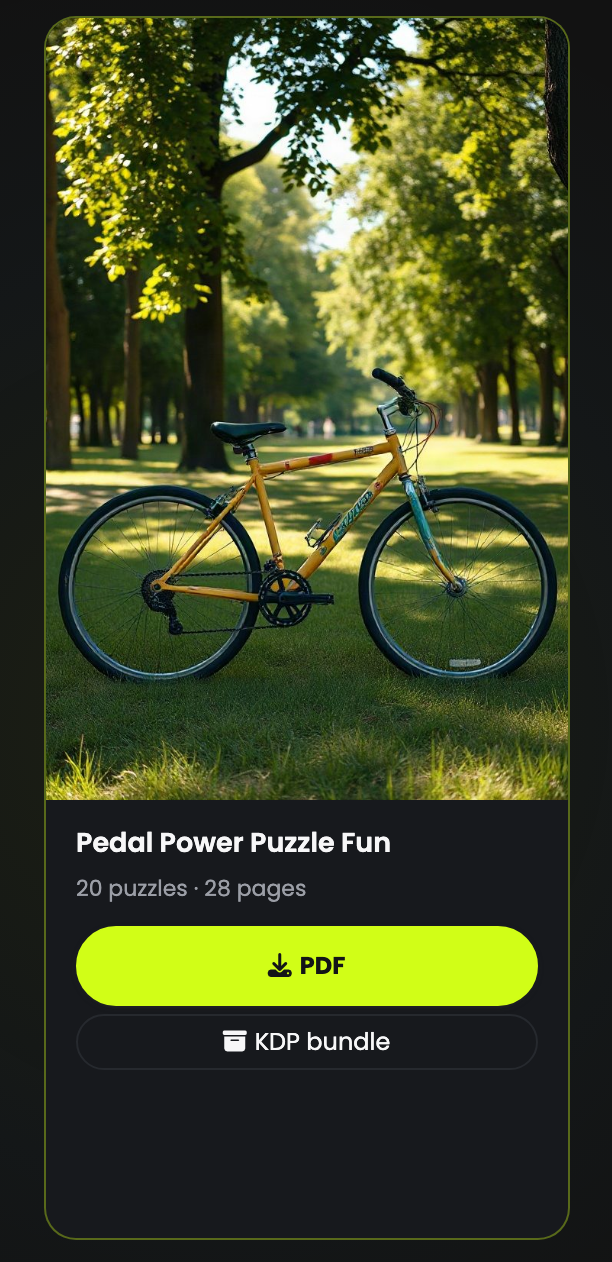
The picture is a scene based on your theme; the title and author are typeset over it for you. Because the inside is black and white, the book can be printed on KDP's cheaper black-and-white interior.
07 Step 5 — Size, paper & author
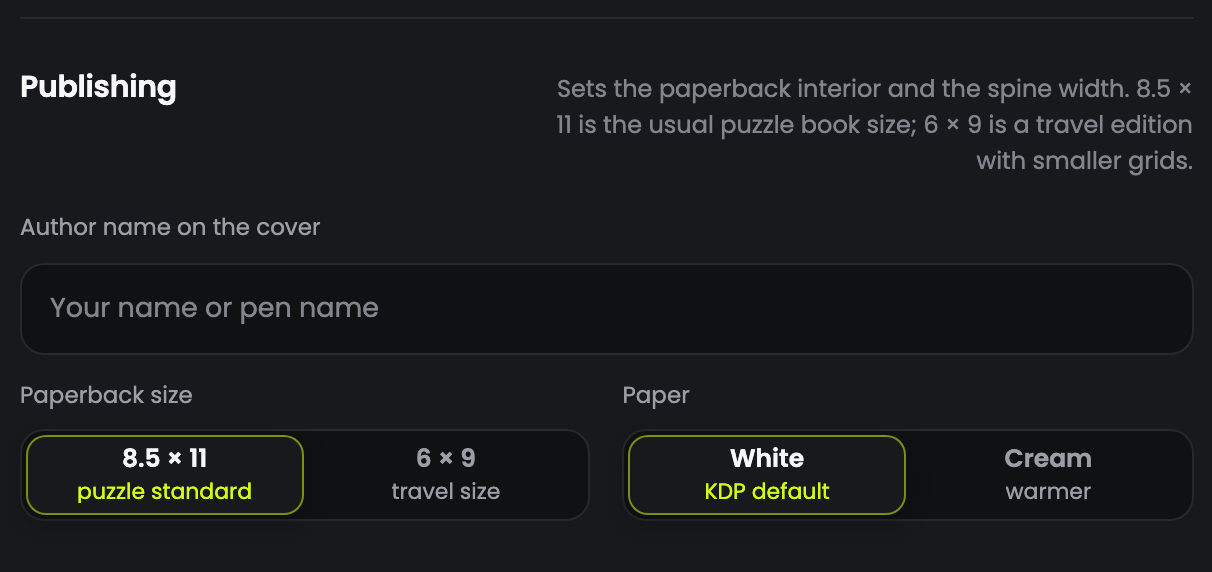
Choose these before you build — the pages and spine are calculated from them.
| Setting | Options |
|---|---|
| Author name on the cover | Your name or a pen name. If you leave it blank, the name on your QynTro account is used — so fill it in if you publish under a pen name. |
| Paperback size | 8.5 × 11 in — the puzzle standard, big grids that are easy to write in · 6 × 9 in — travel size, with smaller grids |
| Paper | White — the KDP default, and the best contrast for grids · Cream — warmer |
08 What a puzzle book costs
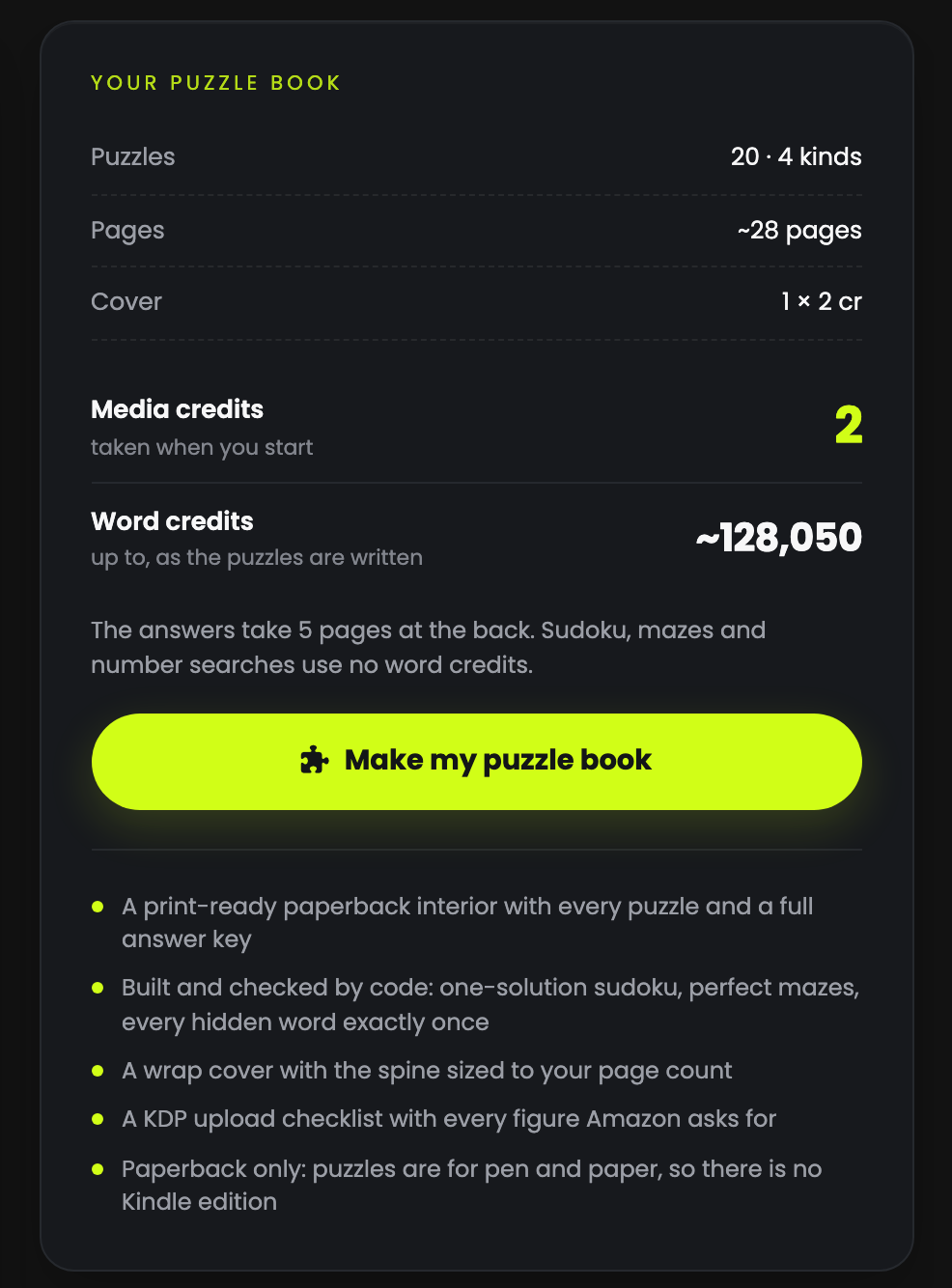
Priced in the panel before you press anything.
| Credit | Pays for | When it is taken |
|---|---|---|
| Media credits | The cover picture — 1 or 2 | Up front, when you start |
| Word credits | The plan, the word lists, clues and sayings | As the puzzles are written — the figure shown is the ceiling |
What that works out at
Measured from the tool itself, on 8.5 × 11 with a GPT Image mini cover (2 media credits; 1 on FLUX):
| Book | Pages | Word credits |
|---|---|---|
| 20 puzzles · all 7 kinds | ~28 | ~118,000 |
| 20 puzzles · word search, crossword, sudoku, maze | ~28 | ~128,000 |
| 60 puzzles · all 7 kinds | ~78 | ~302,000 |
| 150 puzzles · all 7 kinds | ~191 | ~712,000 |
| 100 puzzles · word search only | ~128 | ~541,000 |
| 50 puzzles · crossword only | ~66 | ~733,000 |
| 100 puzzles · sudoku + maze | ~128 | ~77,000 |
| 60 puzzles · sudoku only, 6 × 9 | ~78 | ~53,000 |
Difficulty does not change the price
Easy and hard books of the same size and kinds cost the same.
If the panel says you are short
It tells you plainly — "you have X, this puzzle book needs about Y. Make fewer puzzles, or add credits." Lower the number of puzzles, or swap a crossword for a sudoku, and watch the figure fall.
Cheapest way to try it
20 puzzles, Sudoku and Maze, FLUX cover. A real 28-page paperback for a fraction of the word credits of a written book.
Roughly one page per puzzle
Plus three pages at the front and one answer page for every four puzzles. Books always have at least 24 pages.
09 Inside the finished book
Press Make my puzzle book, and this is what comes back.
Press Make my puzzle book
The book is planned, the word lists and clues are written in batches, each puzzle is built and checked, and the whole thing is typeset and packaged.
You do not need to watch
It runs on our servers. Close the page and come back — the finished book appears in Your books.
| Part | What is in it |
|---|---|
| Title page | The title, subtitle, the kinds of puzzle inside, and the author. |
| Copyright page | Your copyright line, and a note that every puzzle has a single solution and where the answers begin. |
| How to Play | A short rule for each kind in the book, with the pages where the puzzles and answers start. |
| The puzzles | One per page, numbered, the kinds taking turns. |
| Answers | Every solution, four to a page, in puzzle order. |
10 Your files & Amazon KDP
A paperback — puzzles are for pen and paper.
| File | Use it for |
|---|---|
| The puzzle book itself. Sell it as a printable download, use it as a lead magnet, or print it. | |
| KDP bundle → paperback interior | Upload as the manuscript on KDP. Black and white, fonts embedded, no bleed. |
| KDP bundle → wrap cover | Upload as the cover. Back, spine and front on one page, with bleed, at 300 dpi, with the barcode area left clear. |
| KDP bundle → KDP-CHECKLIST.txt | Every figure KDP asks for, plus a description for your listing and keyword advice. |
KDP → Create → Paperback
Copy the title, subtitle, author and description from the checklist.
Leave "Low-content book" unticked
That option is for blank journals and planners. A puzzle book has real content.
Print options
Black & white interior, the paper colour and trim size you chose, no bleed.
Upload the interior, then the cover
Choose "Upload a cover you already have" for the wrap cover. The spine width is already worked out from your page count.
Check the previewer
KDP's print previewer is the last chance to catch anything before you approve.
11 Troubleshooting & FAQ
The button says "Pick at least one kind of puzzle"
No kinds are ticked by default. Tap one or more in Puzzles.
My theme was refused
Puzzle books are made in English. Describe the theme in English, between 3 and 300 characters.
Are the puzzles really solvable?
Yes. Each one is checked by code after it is built: one solution for every sudoku, one path through every maze, and each hidden word or number exactly once in its grid.
The mix of kinds is slightly different from what I picked
If the words written for a puzzle cannot make a valid puzzle after two tries, that puzzle is replaced with one that needs no words — a sudoku or a number search — rather than printing a broken one.
Why does a sudoku page have two grids?
That is how sudoku is laid out: each sudoku puzzle is one page holding two 9 × 9 grids, so a book with 20 sudoku puzzles has 40 grids to solve.
Can I edit a puzzle book afterwards?
Not in Review & edit — that is for written books. To change a puzzle book, make a new one with the settings you want.
Whose name is on the cover?
The Author name on the cover you entered — or, if you left it blank, the name on your QynTro account.
Can I sell what it produces?
Yes. Content generated on a paid plan is yours to use commercially, including selling it on Amazon. You are responsible for checking it before you publish.
Can I change the size after building?
No — the grids, pages and spine are built for the size you chose. Make the book again at the other size.